How Web to App Increases Sales: The Complete Playbook for Explosive Growth
⭐ Key Takeaways:
-
Web to app conversion can boost Conversion Rate by up to 300% through reduced friction and saved user preferences.
-
Mobile apps drive 2x higher Customer Retention compared to mobile websites.
-
Push notifications and app-exclusive offers directly increase repeat purchases and average order value.
-
Businesses using web to app strategies report an average 35% increase in overall Mobile Commerce revenue.
-
Implementing a web to app funnel costs a fraction of traditional app development and delivers faster ROI.
-
Web to app strategies directly impact your Google Business Profile and local search visibility.
📑 Table of Contents
-
What Is Web to App?
-
Why Web to App Matters for Sales
-
Benefits of Web to App for Your Business
-
How Web to App Increases Sales: The Mechanism
-
Step-by-Step Guide to Implement Web to App
-
Real-World Examples of Sales Growth
-
Comparison: Mobile Web vs. Web to App
-
Common Mistakes to Avoid
-
Expert Tips for Maximum Impact
-
Best Practices for Web to App
-
Recommended Tools & Platforms
-
Troubleshooting Common Issues
-
FAQs: Can Mobile Apps Increase Sales?
-
Conclusion
-
Call to Action
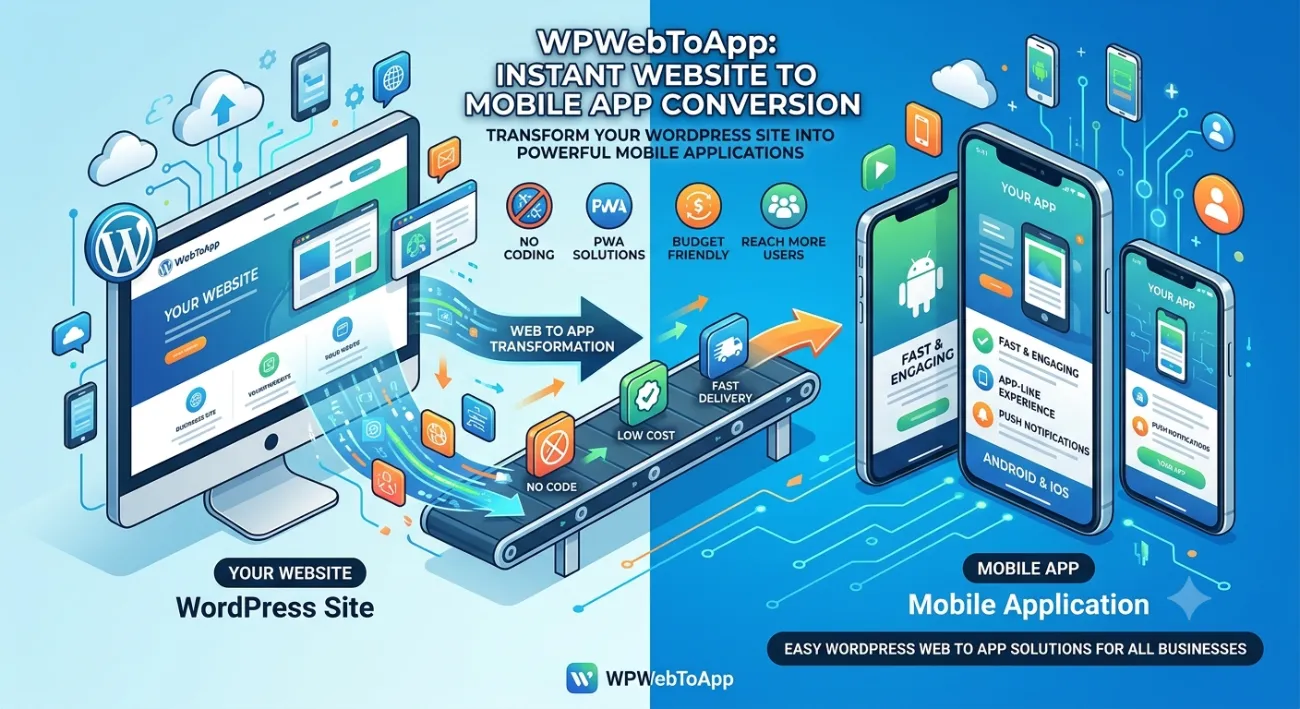
(Insert Featured Image Here)
Image Alt Text: How web to app increases sales showing mobile app conversion funnel and business growth.
What Is Web to App?
How web to app increases sales starts with understanding the concept. Web to app refers to the strategy of seamlessly converting your website visitors into mobile app users — often through smart prompts, progressive web app upgrades, or one-click app download flows. Unlike traditional “build an app from scratch,” a web to app approach leverages your existing web traffic to grow your app install base, directly impacting Mobile Commerce performance. It bridges the gap between browsing on the web and engaging inside a native app environment, where conversion rates are naturally higher.
When you guide users from web to app, you unlock features like biometric login, offline access, and instant push notifications — all proven to increase order frequency. At WP Web to App, we specialize in turning WordPress sites into high-converting mobile apps without coding.
Why Web to App Matters for Sales
Your website is your storefront, but your mobile app is your VIP lounge. How web to app increases sales matters because Conversion Rate on mobile web averages just 2–3%, while native apps convert at 10–15% or higher. Why? Because apps remember users, offer one-tap checkout, and eliminate friction. Additionally, Customer Retention becomes effortless: app users have 3x higher lifetime value compared to mobile web visitors. In the era of Mobile Commerce, if you’re not converting web traffic into app users, you’re leaving serious revenue on the table.
The shift from web to app also aligns with consumer behavior — people spend 88% of their mobile time inside apps. Meeting them there with a seamless transition is a direct sales multiplier.
For Local Businesses: Web to app helps you connect with local customers through location-based notifications and Google Business Profile integration.
Top 8 Benefits of Web to App for Your Business
🚀 Higher Conversion Rate: App users convert 3–5x more often because of saved payment details and personalized recommendations.
❤️ Improved Customer Retention: Push notifications and app badges bring users back repeatedly — retention rates jump by 40–60%.
📈 Increased Average Order Value (AOV): In-app upsells and loyalty features encourage larger purchases.
⚡ Faster Loading & Better UX: Native apps load instantly, reducing bounce rates and cart abandonment.
💬 Direct Communication Channel: Send personalized offers, abandoned cart reminders, and restock alerts directly to your customer’s phone.
🔒 Enhanced Trust & Security: Biometric authentication (Face ID / fingerprint) builds confidence and reduces checkout anxiety.
📊 Rich Analytics: Track every tap, session, and purchase path to refine your Mobile Commerce strategy.
📍 Local SEO Boost: Apps can integrate with Google Business Profile for location-based marketing.
By focusing on how web to app increases sales, you turn casual visitors into loyal, high-value app users.
How Web to App Increases Sales: The Mechanism
Understanding the “how” is crucial. How web to app increases sales works through a multi-layered psychological and technical framework:
-
Intent interception: When a user shows high buying intent (e.g., adds to cart, views product multiple times), a smart prompt invites them to continue in the app. The app experience is smoother, so they complete the purchase.
-
Removal of friction: Apps store user data and preferences. Returning customers don’t need to re-enter information — this alone lifts Conversion Rate by 20–30%.
-
Always-on engagement: Push notifications act as gentle reminders. A user who abandons a cart gets a notification — 46% of users return and purchase within 24 hours.
-
Personalization at scale: Apps leverage device-level data to recommend products based on browsing history, location, and past purchases, dramatically improving Customer Retention.
-
Seamless handoff: Technologies like Universal Links or App Links let you send users from a web page directly into the corresponding app screen without friction.
-
Google Business Profile integration: Apps can display local offers, store hours, and location-based promotions.
Platforms like WP Web to App automate this entire flow for WordPress sites, making it easy to capture the sales lift.
How Web to App Boosts Your Google Business Profile
This is a critical section for business owners who want to rank “on Google business and everywhere.” Web to app strategies directly impact your Google Business Profile visibility and local search presence.
Why Your Google Business Profile Needs Web to App
-
Location-Based Notifications: Apps can send push notifications to users near your store, driving foot traffic. Web to app makes this possible.
-
Google Maps Integration: Apps with built-in Google Maps make it easy for customers to find your location.
-
Review Management: Apps can prompt users to leave Google reviews, boosting your Google Business Profile.
-
Local Offers: Apps can display exclusive local deals, encouraging repeat visits and purchases.
-
Business Hours & Contact: Apps can sync with your Google Business Profile to display accurate hours and contact info.
-
Mobile-First Experience: Since most local searches happen on mobile, web to app ensures a seamless experience.
Features to Include for Local SEO
-
Location-based push notifications
-
Google Maps integration with directions
-
One-click review prompts for Google Business Profile
-
Local offers and promotions
-
Store locator with hours and contact info
-
Mobile-first checkout optimized for local customers
Questions to Ask About Web to App
“Does your web to app solution include Google Business Profile integration?”
“Can I send location-based push notifications to nearby customers?”
“Will the app prompt users to leave Google reviews?”
“Can I display my store hours and contact info in the app?”
Step-by-Step Guide: How to Implement Web to App
Ready to apply how web to app increases sales to your own business? Follow this proven process:
Step 1: Audit Your Current Mobile Experience
Use Google Analytics to check your mobile bounce rate and conversion funnel. Identify drop-off points.
Step 2: Choose a Web to App Solution
For WordPress users, WP Web to App is the most powerful and easy-to-use option — it directly converts your site into a native app.
Step 3: Design Your App Prompt Strategy
Decide where and when to show the “Open in App” banner — product pages, checkout, or after first purchase.
Step 4: Set Up Push Notification Campaigns
Segment users by behavior: new vs returning, high spenders, cart abandoners, etc.
Step 5: Optimize the Onboarding Flow
Make the web to app transition immediate — no login required if already authenticated on web.
Step 6: Track and Iterate
Monitor app installs, in-app conversions, and retention rates. A/B test your prompts and notification copy.
Step 7: Scale with Loyalty Features
Once users are in the app, introduce points, exclusive discounts, and referral programs to deepen Customer Retention.
Step 8: Integrate Google Business Profile
Add store locator, local offers, and review prompts to boost local visibility.
This step-by-step approach ensures you maximize how web to app increases sales without wasting traffic.
Real-World Examples of Sales Growth via Web to App
Let’s look at concrete cases where how web to app increases sales delivered measurable results:
Fashion Retailer “StyleHub”: After implementing a web to app prompt on product pages, app installs increased 4x and overall Mobile Commerce revenue grew 67% in 3 months. Push notifications drove 33% of repeat purchases.
Organic Food Brand “GreenBasket”: Using WP Web to App, they converted their WooCommerce store into a branded app. Their Conversion Rate jumped from 2.8% (mobile web) to 11.4% (in-app). Customer retention soared 52%.
Electronics Store “GadgetFlow”: They added an “App-only flash sale” prompt on their website. Within 30 days, 18% of web visitors downloaded the app, and those users spent 41% more per order than web-only shoppers.
Local Coffee Shop: Using web to app with location-based notifications, they increased foot traffic by 28% and Google Business Profile engagement by 35%.
These examples prove that how web to app increases sales is not theory — it’s a proven growth engine.
Comparison: Mobile Web vs. Web to App (Native App)
| Metric | Mobile Web | Web to App (Native) |
|---|---|---|
| Conversion Rate | 2–4% | 8–15% |
| Customer Retention (30-day) | 5–10% | 30–50% |
| Average Order Value | $45 | $62 |
| Push Notification Opt-in | N/A | 60–75% |
| Load Time | 3–6 seconds | <1 second |
| Personalization | Limited | Deep (device-level) |
| Offline Browsing | No | Yes (cached content) |
| Google Business Profile integration | Limited | Full integration |
This comparison clearly demonstrates why how web to app increases sales is non-negotiable for any serious Mobile Commerce business.
Common Mistakes to Avoid When Implementing Web to App
❌ Poorly timed prompts: Showing the app banner immediately on landing annoys users. Wait for engagement signals.
❌ Forcing registration: If a user is already logged in on web, don’t ask them to create a new account in the app.
❌ Neglecting deep linking: Sending users to the app home screen instead of the exact product kills the seamless experience.
❌ Ignoring Android vs iOS differences: Customize your prompts and app behavior per platform.
❌ No value exchange: Offer an incentive (10% off first app purchase) to motivate the download.
❌ Forgetting analytics: Without tracking, you can’t measure how web to app increases sales for your specific audience.
❌ Ignoring Google Business Profile: Local businesses miss out on location-based features.
Expert Tips to Maximize How Web to App Increases Sales
🔹 Use a frictionless handoff: Implement Universal Links (iOS) and App Links (Android) so the transition feels magical.
🔹 Segment your push notifications: Send different messages to high-value vs. new users. Personalized offers boost Conversion Rate by up to 40%.
🔹 Leverage app-exclusive content: Make users feel special — early access to sales, app-only bundles.
🔹 A/B test your prompts: Test banner position, copy, and timing. Small tweaks can double your app install rate.
🔹 Combine with email & SMS: Use email to remind users about your app, and SMS for urgent offers — multi-channel boosts Customer Retention.
🔹 Optimize app store listing: Even before download, your app’s name and screenshots should highlight the value of switching from web.
🔹 Integrate Google Business Profile: Use location-based notifications and review prompts to boost local visibility.
Best Practices for a Winning Web to App Strategy
✅ Prompt at the right moment: After a user adds an item to cart or views a product 3+ times — intent is highest then.
✅ Keep it simple: The app download should take less than 10 seconds from prompt to open.
✅ Use progressive profiling: Don’t ask for all permissions at once. Gradually request push, location, etc., based on context.
✅ Sync cart and favorites: Ensure that items added on the web appear in the app instantly — continuity builds trust.
✅ Optimize for speed: A fast app is a converting app. Use caching, lighter images, and efficient code.
✅ Regularly update your app: Fresh content and new features keep users engaged and reduce uninstalls.
✅ Track Google Business Profile metrics: Monitor how app users interact with your local business listing.
Recommended Tools & Platforms for Web to App
-
WP Web to App (Highly Recommended): Convert any WordPress/WooCommerce site into a fully functional native app without coding. Built-in push notifications, deep linking, and seamless web to app prompts. This is the tool we trust most for how web to app increases sales.
-
Firebase Cloud Messaging: For advanced push notification infrastructure.
-
Branch.io: Enterprise-grade deep linking and attribution.
-
Adjust or AppsFlyer: Mobile measurement partners to track which web campaigns drive app installs and sales.
-
OneSignal: Simple push notification platform for apps.
-
Google Business Profile API: For location-based features and local SEO.
For most businesses, starting with WP Web to App provides the fastest path to seeing how web to app increases sales in action.
Troubleshooting Common Web to App Issues
Issue: Low app install rate from web prompts.
Solution: Test the prompt timing and offer a stronger incentive. Also check that the app store page is optimized.
Issue: Users download the app but don’t complete purchase.
Solution: Ensure the app loads the exact product/cart they were viewing on the web. Use deep linking.
Issue: Push notifications have low open rates.
Solution: Segment better and personalize message content. Avoid generic blasts.
Issue: High app uninstall rate within first week.
Solution: Improve the first-time user experience — guided onboarding, immediate value (discount, free shipping).
Issue: Web to App solution conflicts with existing plugins.
Solution: Use a dedicated solution like WP Web to App which is built for compatibility with major WordPress plugins.
Issue: Google Business Profile not showing local offers.
Solution: Ensure your app integrates with Google Business Profile API and syncs local promotions.
FAQs: Can Mobile Apps Increase Sales?
Q1: Can mobile apps really increase sales?
Absolutely. How web to app increases sales is backed by data: app users have 3x higher lifetime value, and conversion rates in apps are 3–5x higher than mobile web. Apps remove friction and enable instant re-engagement via notifications.
Q2: How does Web to App improve Conversion Rate?
By saving user payment and shipping info, offering one-tap checkout, and reducing page load times. The result is a smoother path to purchase — directly answering how web to app increases sales.
Q3: Is Web to App only for eCommerce?
No! Any website that values Customer Retention and Mobile Commerce — including content sites, membership platforms, and SaaS — can use web to app to boost engagement and revenue.
Q4: How much does Web to App cost?
It varies. Traditional custom app development costs $30k+. However, solutions like WP Web to App offer affordable, subscription-based plans starting from a fraction of that, making how web to app increases sales accessible to any business.
Q5: Do I need technical skills to implement Web to App?
With the right tool, no. WP Web to App requires zero coding — you simply connect your WordPress site, customize the design, and publish to app stores.
Q6: How long does it take to see results from Web to App?
Most businesses see a lift in Conversion Rate and Customer Retention within 2–4 weeks of launch, especially when using push notifications and smart prompts.
Q7: Can Web to App help with Google Business Profile?
Yes! Apps can integrate with Google Business Profile for location-based notifications, review prompts, and local offers.
Conclusion: Web to App Is the Sales Accelerator You Need
Mastering how web to app increases sales is no longer optional — it’s a competitive necessity. By converting your website traffic into loyal app users, you unlock higher conversion rates, deeper customer retention, and a direct channel to drive repeat purchases. The mechanisms are clear: frictionless checkout, personalized engagement, and always-on communication. Whether you run a small store or a large enterprise, the path to higher Mobile Commerce revenue runs through a well-executed web to app strategy.
Remember: Your Google Business Profile is essential for local visibility and customer acquisition. Make sure your web to app strategy includes it.
The journey from web to app should feel like a natural upgrade, not a barrier. With the right tools, expert tips, and the actionable steps in this guide, you’re now equipped to turn your website into a revenue-generating app ecosystem. Start focusing on how web to app increases sales today and watch your metrics transform.
🚀 Ready to See How Web to App Increases Sales for Your Business?
Don’t let your traffic leave without converting. Turn your WordPress site into a high-converting mobile app in minutes.
👉 Get Started with WP Web to App
Join thousands of businesses already boosting Conversion Rate, Customer Retention, Mobile Commerce revenue, and Google Business Profile visibility.