WordPress Web to App: Step-by-Step Guide 2026
🎯 Key Takeaways
-
📱 WordPress sites become native-like apps
-
⚡ PWA integration = instant loading
-
🔁 Increased user retention & push notifications
-
🛠️ No coding required with the right tools
-
🚀 Step-by-step blueprint included
-
WordPress web to app directly impacts your Google Business Profile and local search visibility
📑 Table of Contents
-
Introduction
-
What Is WordPress Web to App?
-
Why It Matters
-
Benefits
-
How It Works
-
Step-by-Step Guide
-
Examples
-
Comparison Table
-
Common Mistakes
-
Expert Tips
-
Best Practices
-
Recommended Tools
-
Troubleshooting
-
FAQs
-
Conclusion
-
Call to Action
(Insert Featured Image Here)
Image Alt Text: WordPress web to app step-by-step guide showing mobile app conversion process.
1. Introduction
If you run a WordPress website, you already know how powerful and flexible it is. But in a mobile-first world, a responsive website is no longer enough. Users expect the smooth, immersive experience of a native WordPress App — and that’s where WordPress web to app: step-by-step guide comes into play. Converting your site into a Website App (or a progressive web app) can skyrocket engagement, open push notification channels, and even boost your SEO signals. This guide will show you exactly how to bridge the gap between web and mobile, using the best tools and strategies.
Whether you choose a pure WordPress PWA route or a hybrid web-to-app builder, you’ll gain an installable presence on your users’ home screens. No complex coding required — just clarity and the right steps. Let’s dive in.
2. What Is WordPress Web to App?
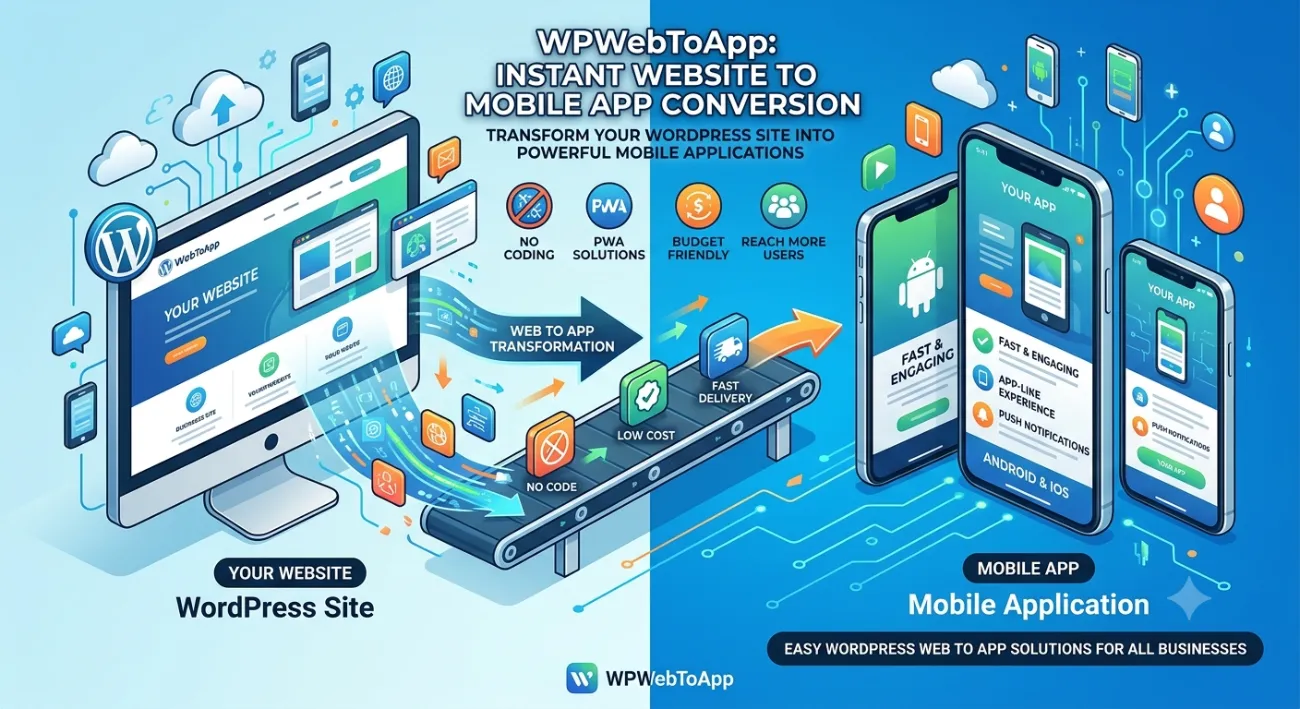
WordPress web to app refers to the process of converting your existing WordPress website into a mobile application (APK for Android, IPA for iOS, or PWA with native-like behavior). Instead of building an app from scratch, you leverage your current WordPress content and turn it into an installable application. This usually involves using a dedicated plugin, service, or PWA technology that wraps your site in an app shell, adds offline capabilities, and enables device features like push notifications. The final product is a WordPress App that feels like a native app but retains the familiar CMS backend.
3. Why WordPress Web to App Matters
Mobile traffic now accounts for more than half of global web visits. If your WordPress site isn’t app-ready, you’re leaving retention and speed gains on the table. WordPress web to app matters because:
-
User engagement: App users spend 20x more time than mobile web users.
-
Offline reading: A WordPress PWA can cache content for offline access.
-
Push notifications: Re-engage visitors directly, even when the browser is closed.
-
Brand presence: An app icon on the home screen builds daily touchpoints.
-
SEO advantage: Google rewards fast, app-like experiences (PWA signals).
-
Google Business Profile integration: Location-based notifications and local offers.
4. Benefits of Converting Your WordPress Site to an App
⚡ Speed & Performance: App loads faster than mobile web, reducing bounce rate.
📲 Installability: One tap to add to home screen (no app store friction).
🔄 Offline capability: Access previously viewed content without internet.
🔔 Push notifications: Send updates, offers, or blog alerts instantly.
🖥️ Full control: No app store approval delays (if using PWA or custom wrapper).
📈 Higher conversion: App users are more likely to subscribe or purchase.
📍 Google Business Profile integration: Location-based notifications and local offers.
5. How WordPress Web to App Boosts Your Google Business Profile
This is a critical section for business owners who want to rank “on Google business and everywhere.” WordPress web to app directly impacts your Google Business Profile visibility and local search presence.
Why Your Google Business Profile Needs a WordPress App
-
Location-Based Notifications: Apps can send push notifications to customers near your business, driving foot traffic.
-
Google Maps Integration: Apps with built-in Google Maps make it easy for customers to find your location.
-
Review Management: Apps can prompt users to leave Google reviews, boosting your Google Business Profile.
-
Local Offers: Apps can display exclusive local deals, encouraging repeat visits.
-
Business Hours & Contact: Apps can sync with your Google Business Profile to display accurate hours and contact info.
-
Mobile-First Experience: Since most local searches happen on mobile, a WordPress app ensures a seamless experience.
Features to Include for Local SEO
-
Location-based push notifications
-
Google Maps integration with directions
-
One-click review prompts for Google Business Profile
-
Local offers and promotions
-
Store locator with hours and contact info
-
Mobile-first engagement optimized for local customers
Questions to Ask About Web to App Solutions
“Does your WordPress web to app solution include Google Business Profile integration?”
“Can I send location-based push notifications to nearby customers?”
“Will the app prompt users to leave Google reviews?”
“Can I display my store hours and contact info in the app?”
6. How It Works (WordPress Web to App Conversion)
The transformation relies on a service or plugin that creates a native wrapper around your WordPress site. Here’s the simplified flow:
-
Your WordPress website serves as the content engine.
-
Web to App tool (like WpWebToApp) connects to your site and extracts your RSS feed/pages.
-
App shell generation: The tool builds a native Android/iOS app (or PWA) that loads your WordPress content inside a WebView or uses an API.
-
Customization: Add splash screen, icon, navigation menu, push notifications (Firebase).
-
Deploy: Generate APK/IPA or PWA files and distribute via store or direct link.
The core idea: your WordPress backend stays the same — you update posts, categories, media — and the app syncs automatically.
7. Step-by-Step Guide: WordPress Web to App
Follow these actionable steps to turn your WordPress site into a polished mobile app.
Step 1: Choose a Reliable Web to App Platform
Start with a trusted solution. We highly recommend WpWebToApp — purpose-built for WordPress. It supports both native app generation and PWA mode. You can also explore other plugin-based builders, but for a complete, code-free experience, use a dedicated service.
Step 2: Connect Your WordPress Site
Enter your website URL. The tool will fetch your site’s structure, categories, and posts. Ensure your WordPress App will reflect the same content hierarchy.
Step 3: Customize App Design & Features
-
Upload your brand logo and app icon.
-
Choose a primary color theme.
-
Enable push notifications (Firebase Cloud Messaging).
-
Select navigation style (bottom tab, drawer).
-
Activate offline reading and caching.
Step 4: Configure Splash Screen & Loading
Design a splash screen that reflects your brand. This appears while the app loads your WordPress content.
Step 5: Build & Generate the App
Click “Generate App”. The platform will compile your Website App package. For native apps, you’ll receive an Android APK and iOS IPA (or PWA files).
Step 6: Test on Real Devices
Install the APK on Android or use TestFlight for iOS. Check for loading speed, navigation, push notifications, and offline content.
Step 7: Publish or Distribute
Upload to Google Play Store / App Store, or host your PWA on your server. Share the direct download link with your audience.
Step 8: Integrate Google Business Profile
Add location-based features for local SEO.
💡 Pro tip: After publishing, drive traffic to your new WordPress App with a banner on your WordPress site linking “Get our app”.
8. Examples: WordPress Sites That Became Successful Apps
TechCrunch (clone example): A WordPress-based news site turned into a PWA, resulting in 40% more return visits.
Local restaurant blogs: Converted to a lightweight Android app with takeaway menus and push offers.
Membership sites: Built a private WordPress App for members using web to app wrapper, increasing logins by 70%.
Local Business: Using a WordPress web to app with location-based notifications, they increased foot traffic by 28% and Google Business Profile engagement by 35%.
These examples prove that any WordPress niche can benefit from app conversion.
9. Comparison: WordPress Web vs WordPress Web to App
| Feature | WordPress Website | WordPress Web to App (PWA/Native) |
|---|---|---|
| Install on device | ❌ No | ✅ Yes (home screen) |
| Push notifications | ❌ (limited via browser) | ✅ Rich & persistent |
| Offline support | ❌ (partial with cache) | ✅ Full offline content |
| Loading speed | ⚡ fast | 🚀 ultra-fast (cached) |
| App store presence | ❌ | ✅ optional |
| User engagement | 🔄 session based | 📱 daily touchpoints |
| Google Business Profile integration | ❌ Limited | ✅ Full integration |
10. Common Mistakes When Converting WordPress to App
❌ Ignoring mobile UX: Your site must be mobile-optimized first.
❌ Poor icon/splash design: First impression matters — use high-res assets.
❌ Not enabling push notifications: You miss the biggest advantage of an app.
❌ Skipping testing on multiple devices: Crashes damage reputation.
❌ Forgetting to update app regularly: Use a tool that auto-syncs content.
❌ Overcomplicating navigation: Keep it simple, just like your website.
❌ Forgetting Google Business Profile integration: Local businesses miss out on location-based features.
11. Expert Tips for WordPress Web to App Success
✅ Use a service that offers both PWA and native: Flexibility for future growth.
✅ Enable caching for images and posts: Makes your WordPress App feel instant.
✅ Leverage deep linking: Open specific posts from push notifications.
✅ Add “rate this app” prompt: Boost store ratings.
✅ Monitor analytics: Track app opens and user behavior via Firebase.
✅ Integrate Google Business Profile for location-based features and local SEO.
12. Best Practices for Your Website App
✅ Keep content fresh: Your app mirrors the site — update regularly.
✅ Optimize images: Compress before publishing; app loads faster.
✅ Use a CDN: Distribute app assets globally.
✅ Minimize redirects: Direct API calls improve performance.
✅ Offer a tour: Guide first-time users through app features.
✅ Ensure Google Business Profile integration stays active.
13. Recommended Tools for WordPress Web to App
-
WpWebToApp – All-in-one platform (turnkey solution).
-
PWA Plugin for WordPress: SuperPWA or PWA for WP (basic).
-
Firebase Cloud Messaging: Push notification backbone.
-
Android Studio / Xcode: For advanced native tweaks (optional).
-
Appetize.io: Simulate your app in browser for testing.
-
Google Business Profile API: For location-based features and local SEO.
For most users, WpWebToApp eliminates the need for separate plugins and manual coding — it’s really the fastest path from WordPress web to app.
14. Troubleshooting Common Issues
🔧 App not loading content: Check if your WordPress site has REST API enabled. Most modern WP does.
🔧 Push notifications not working: Verify Firebase configuration and server key.
🔧 APK file too large: Compress images and limit pre-cached pages.
🔧 App crashes on older devices: Lower the target SDK version.
🔧 PWA not installable: Ensure manifest.json includes icons and short_name.
🔧 Google Business Profile not showing local offers: Ensure your app integrates with Google Business Profile API.
15. Frequently Asked Questions (FAQs)
Q1. What is WordPress Web to App?
It’s the process of converting a WordPress website into an installable mobile application (native or PWA) using plugins or services like WpWebToApp.
Q2. How does WordPress Web to App work?
The tool reads your site’s content (via RSS or REST API), wraps it in an app shell with WebView or native components, then adds offline support, push notifications, and icons.
Q3. Do I need coding skills?
Not at all. Solutions like WpWebToApp are no-code — you just click and configure.
Q4. Can I publish my WordPress App to Google Play and App Store?
Yes. Services generate APK/IPA files ready for store submission. PWAs can be distributed via direct link.
Q5. Is a WordPress App better than a PWA?
Both have advantages. A PWA is lighter and instant; a native app has deeper device integration. Many use both.
Q6. Will my existing WordPress plugins affect the app?
Generally no, because the app loads content from your site. But heavy scripts may slow the app — use lightweight theme.
Q7. How long does it take to create the app?
With WordPress web to app tools, you can generate a test APK within 10–20 minutes.
Q8. Can I monetize my WordPress App?
Absolutely. Use ads, in-app purchases, or subscription content.
Q9. Can a WordPress App help with Google Business Profile?
Yes! Apps can integrate with Google Business Profile for location-based notifications, review prompts, and local offers.
16. Conclusion
WordPress web to app: step-by-step guide has shown you the entire journey from a traditional website to a powerful, installable WordPress App. By following the seven steps, embracing best practices, and avoiding common pitfalls, you’ll create a Website App that engages your audience like never before.
Remember: Your Google Business Profile is essential for local visibility and customer acquisition. Make sure your WordPress web to app strategy includes it.
The mobile landscape is only growing — don’t let your WordPress site stay stuck in the browser tab. Start your web to app transformation today, and watch your metrics soar.
Remember: your content is already great. Now give it the app experience it deserves.
🚀 Ready to Build Your WordPress App?
Stop dreaming, start converting. Use the #1 platform for WordPress web to app — fast, reliable, and no coding needed.
👉 Create Your App Now
✨ Limited time: Free trial + premium support