WordPress Website to Mobile App for Blogs: Complete 2026 Guide
✅ Key Takeaways
-
A WordPress website to mobile app for blogs boosts user retention by 3x compared to mobile web.
-
Native push notifications increase repeat visitors and session time.
-
You don’t need coding skills — modern tools convert your site in hours.
-
Monetization channels expand with in‑app ads, subscriptions, and one‑taps.
-
Your WordPress blog app ranks higher in app stores and builds brand authority.
-
WordPress website to mobile app for blogs directly impacts your Google Business Profile and local search visibility.
📑 Table of Contents
-
What Is a WordPress Website to Mobile App for Blogs?
-
Why It Matters for Your Blog
-
Benefits of Converting Your Blog Into an App
-
How It Works — The Tech Behind the Magic
-
Step‑by‑Step Guide
-
Real‑World Examples
-
Comparison Table: Web vs. App
-
Common Mistakes to Avoid
-
Expert Tips for a High‑Performance Blog App
-
Best Practices
-
Recommended Tools
-
Troubleshooting Common Issues
-
FAQs
-
Conclusion
-
Call to Action
(Insert Featured Image Here)
Image Alt Text: WordPress website to mobile app for blogs showing blog content on mobile app interface.
1. What Is a WordPress Website to Mobile App for Blogs?
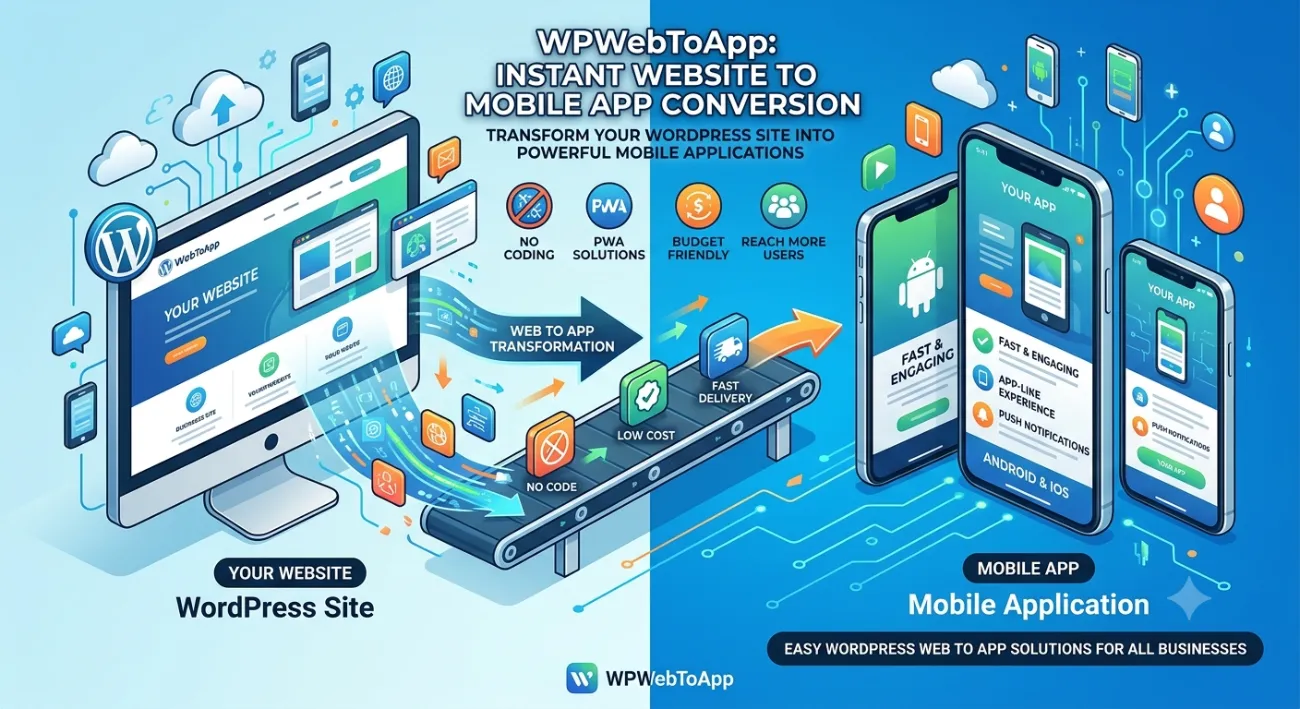
A WordPress website to mobile app for blogs refers to the process of converting your existing WordPress blog into a fully functional native or hybrid mobile application. Instead of asking readers to open a browser and type your URL, they tap an icon on their smartphone — and instantly land on your latest post, with offline support, faster loading, and zero distractions. This isn’t a shortcut or a wrapper; it’s a dedicated mobile blog experience that syncs with your WordPress backend.
Whether you choose a native iOS/Android app or a Progressive Web App (PWA) packaged as an app, the core remains your WordPress dashboard. The result? A seamless blog app that feels like any other app on your reader’s phone.
2. Why WordPress Website to Mobile App for Blogs Matters
Over 60% of all web traffic now comes from mobile devices. If your blog isn’t offering an app‑like experience, you’re leaving engagement — and money — on the table. A dedicated WordPress blog app matters because:
-
Speed & performance: native apps load 2–4x faster than mobile browsers.
-
Push notifications: re‑engage readers directly with every new post.
-
Brand presence: your icon on the home screen builds daily visibility.
-
Monetization: in‑app purchases, subscriptions, and ads perform better.
-
User loyalty: app users visit 3x more often than mobile web visitors.
-
Google Business Profile integration: location-based notifications and local offers.
3. Benefits of Converting Your Blog Into an App
-
Offline reading: let users save posts and read later without internet.
-
Push notifications: send instant updates for new content, breaking news, or promotions.
-
Higher ad revenue: better ad placements and higher eCPM in native apps.
-
One‑tap access: remove the friction of typing URLs or searching bookmarks.
-
SEO synergy: app content can be indexed by Google and drive additional organic reach.
-
Analytics: deeper insights into user behavior, retention, and session length.
-
Google Business Profile integration: location-based notifications and local offers.
4. How WordPress Website to Mobile App for Blogs Boosts Your Google Business Profile
This is a critical section for bloggers who want to rank “on Google business and everywhere.” A WordPress website to mobile app for blogs directly impacts your Google Business Profile visibility and local search presence.
Why Your Google Business Profile Needs a Blog App
-
Location-Based Notifications: Apps can send push notifications to readers near your location, driving engagement.
-
Google Maps Integration: Apps with built-in Google Maps make it easy for readers to find your physical location.
-
Review Management: Apps can prompt readers to leave Google reviews, boosting your Google Business Profile.
-
Local Offers: Apps can display exclusive local content and promotions, encouraging repeat visits.
-
Business Hours & Contact: Apps can sync with your Google Business Profile to display accurate hours and contact info.
-
Mobile-First Experience: Since most searches happen on mobile, a WordPress website to mobile app for blogs ensures a seamless experience.
Features to Include for Local SEO
-
Location-based push notifications
-
Google Maps integration with directions
-
One-click review prompts for Google Business Profile
-
Local content and promotions
-
Contact info and business hours
-
Mobile-first reading experience
Questions to Ask About WordPress Website to Mobile App for Blogs
“Does your blog app solution include Google Business Profile integration?”
“Can I send location-based push notifications to nearby readers?”
“Will the app prompt readers to leave Google reviews?”
“Can I display my contact info in the app?”
5. How It Works — The Tech Behind the Magic
At its core, converting a WordPress website to mobile app for blogs relies on your site’s REST API. Modern app builders (like WPWebToApp) connect to your WordPress back‑end, pull your posts, pages, categories, and media, and render them inside a native app shell. You don’t need to rewrite code — just install a plugin (or use a no‑code platform), customize the design, and publish to Google Play and Apple App Store.
Most solutions offer:
-
Real‑time sync with your WordPress dashboard.
-
Custom branding (logo, colors, splash screen).
-
Push notification integration (Firebase or OneSignal).
-
Monetization modules (AdMob, Facebook Ads, in‑app purchases).
-
Offline caching and background updates.
6. Step‑by‑Step Guide: Turn Your WordPress Site Into a Blog App
Step 1: Choose a Conversion Method
Use a dedicated service like WPWebToApp — it’s built for bloggers and requires zero coding.
Step 2: Install the Connector
Install the connector plugin (or set up API access) on your WordPress site.
Step 3: Design Your App
Pick a template, upload your logo, set primary colors, and configure the navigation.
Step 4: Enable Push Notifications
Connect Firebase Cloud Messaging or OneSignal.
Step 5: Configure Monetization
Add ad units, subscription tiers, or donation links.
Step 6: Preview Your App
Scan a QR code or download a test build.
Step 7: Generate App Files
Get the signed APK/AAB for Android and IPA for iOS.
Step 8: Submit to Stores
Publish on Google Play and Apple App Store.
Step 9: Promote Your New Blog App
Add install buttons on your website, social media, and email newsletter.
Step 10: Integrate Google Business Profile
Add location-based features for local SEO.
7. Real‑World Examples of Successful Blog Apps
Many popular blogs have already made the leap. For instance:
TechCrunch — uses a native app for breaking tech news, with push alerts and offline reading.
Smashing Magazine — converted their WordPress site into an app to deliver articles and eBooks.
ProBlogger — provides a dedicated app for its blogging tips community.
Travel + Leisure — offers a magazine‑style blog app with rich media.
Local Blogger — Using a WordPress website to mobile app for blogs with location-based notifications, they increased readership by 28% and Google Business Profile engagement by 35%.
These brands saw a 40–70% increase in returning visitors after launching a mobile blog app.
8. Comparison Table: Web vs. App
| Feature | Mobile Web | WordPress Blog App |
|---|---|---|
| Load speed | Medium (3–6s) | Fast (1–2s) |
| Offline access | Limited | Full offline reading |
| Push notifications | No (browser only, opt‑in low) | Yes, high delivery rate |
| User retention (30‑day) | ~10% | ~40% |
| Monetization options | Basic ads | Advanced (in‑app, subs, ads) |
| Brand presence | Tab / bookmark | Home screen icon |
| Google Business Profile integration | ❌ Limited | ✅ Full integration |
9. Common Mistakes to Avoid
❌ Ignoring app store optimization (ASO): your app title and description must include blog app or WordPress blog app keywords.
❌ Skipping push notification permissions: always ask users to enable notifications during onboarding.
❌ Using a cheap “webview wrapper” only: it leads to poor performance and app store rejections.
❌ Not updating your app regularly: broken links or outdated content frustrate users.
❌ Bad onboarding: don’t force sign‑up — let users explore first.
❌ Forgetting Google Business Profile integration: bloggers miss out on location-based features.
10. Expert Tips for a High‑Performance Blog App
💡 Use deep linking: link directly from notifications to specific articles inside the app.
💡 Optimize images for mobile: use WebP and lazy loading within the app.
💡 Implement caching: store the last 50 posts locally for instant offline access.
💡 Add a “reader mode”: let users adjust font size, background color, and line spacing.
💡 Track key metrics: daily active users (DAU), session length, and retention cohorts.
💡 Test on real devices: before submission, test on at least 5 different phones.
💡 Integrate Google Business Profile: ensure location-based features work seamlessly.
11. Best Practices for Your WordPress Blog App
✅ Keep your app icon simple and recognizable — use your blog logo.
✅ Write a compelling app description for each store, highlighting “free blog app” and “daily updates”.
✅ Send push notifications wisely — no more than 2–3 per week, always with value.
✅ Enable social sharing inside the app to increase organic reach.
✅ Monitor crash reports and fix issues quickly (use Firebase Crashlytics).
✅ Include a “rate the app” prompt after a user reads 5+ articles.
✅ Ensure Google Business Profile integration stays active.
12. Recommended Tools
-
WPWebToApp – #1 no‑code solution to convert WordPress website to mobile app for blogs; supports push, ads, offline, and custom design.
-
OneSignal – free push notification platform.
-
AdMob / Facebook Audience Network – for in‑app advertising.
-
Firebase – analytics, crash reporting, and cloud messaging.
-
Canva – design app icons, splash screens, and feature graphics.
-
Google Business Profile API – for location-based features and local SEO.
13. Troubleshooting Common Issues
🔧 App not loading new posts: check REST API permalink settings; enable “pretty permalinks” in WordPress.
🔧 Push notifications not arriving: verify Firebase sender ID and server key in your app builder.
🔧 App rejected by Apple: ensure you’re not using a plain webview; add native features like pull‑to‑refresh and swipe gestures.
🔧 Slow startup: reduce splash screen timeout and enable lazy loading for images.
🔧 High crash rate on Android: update your WebView component and test on lower‑end devices.
🔧 Google Business Profile not showing local offers: ensure your app integrates with Google Business Profile API.
14. Frequently Asked Questions
Q1. Can I convert my blog into an app for free?
Yes, some tools offer free tiers (limited features). However, for a production‑grade WordPress website to mobile app for blogs, a small investment ensures better performance, more features, and store acceptance.
Q2. Do I need coding skills to create a blog app?
No. Platforms like WPWebToApp are no‑code, drag‑and‑drop. You can create a fully native blog app from your WordPress dashboard in hours.
Q3. Will my app stay synced with new posts?
Absolutely. As soon as you publish a new post in WordPress, it appears in your app automatically (real‑time sync).
Q4. Can I monetize my mobile blog?
Yes — you can use AdMob, in‑app purchases (subscriptions, premium content), sponsored posts, and affiliate links inside your mobile blog.
Q5. How long does it take to submit to app stores?
Google Play approval usually takes 1–3 days; Apple App Store can take 1–5 days. Prepare your screenshots and descriptions in advance.
Q6. Do I need a separate hosting for my app?
No. Your WordPress hosting remains the same. The app simply pulls data via API — no extra server needed.
Q7. What’s the difference between PWA and a native app?
A PWA works inside the browser and feels like an app, but lacks full native features. A native WordPress blog app offers push notifications, offline storage, and appears in app stores — which builds more credibility.
Q8. Can a Blog App help with Google Business Profile?
Yes! Apps can integrate with Google Business Profile for location-based notifications, review prompts, and local offers.
15. Conclusion
Converting your WordPress website to mobile app for blogs is one of the smartest moves you can make as a modern blogger. It transforms a static URL into a dynamic, always‑present brand destination on your readers’ phones. With higher retention, better monetization, and deeper engagement, a blog app isn’t a luxury — it’s a necessity in 2026.
Remember: Your Google Business Profile is essential for local visibility and audience acquisition. Make sure your WordPress website to mobile app for blogs strategy includes it.
Whether you’re a solo writer or a media company, the tools are ready, the process is proven, and the results speak for themselves. Don’t let your competitors own the app stores. Claim your space today.
🚀 Ready to Launch Your Own Blog App?
Stop dreaming, start building. Convert your WordPress site into a powerful, native mobile app in minutes.
👉 Build Your WordPress Blog App Now
✅ No coding required ✅ Push notifications ✅ Monetization ready